
Managing Strong Personalities: Turning Diverse Perspectives into Leadership Success


An executive who fills a room with pace and opinions. A director who questions every assumption. A leader who says very little and is rarely swayed. These individuals are often labeled as “strong personalities,” and if we’re honest, we may treat them as a challenge.
In my experience, strong personalities in and of themselves are not a problem. They can even be an asset.
The real challenge is that individuals rarely have a shared language to understand, name and work with the differences between their teammates. Without the context, skills and psychological safety to collaborate effectively, people end up talking past each other and lose out on the wisdom in the room that will make their concepts, processes, strategies and people sharper.
The cost of workplace friction
Friction is expensive. Managers spend an average of 4.44 hours each week addressing interpersonal conflict, which adds up to nearly 29 working days every year and an estimated $157 billion lost annually in the US alone.
That is nearly a month that could have gone to coaching, strategy and growth.
The good news is that this cost isn’t inevitable. By giving leaders more tools to productively discuss differences and resolve misalignment, work can feel more frictionless.
What personality clashes look like in the real world
Imagine a leadership team preparing to launch a new product. The CRO is third-third Assertive, meaning they like a driving pace. This individual wanted the product launched yesterday. The Operations Director has a strong Structural preference, so he is pushing to see the process, timeline and risks before saying yes. The Head of Strategy leans Conceptual and keeps raising bigger ideas that feel like a detour to everyone else.
Without a shared language, this scenario may play out like this: The CRO sees the Operations Director as a roadblock. The Operations Director sees the CRO as reckless. The Head of Strategy is frustrated that no one is listening to them. These are three capable leaders with three valid perspectives, resulting in a stalled project and a delayed go-to-market path.
Now imagine the same team with a common vocabulary. The CRO recognizes that the Operations Director is asking those questions to protect the launch and ensure it runs seamlessly, not because they want to delay it. The Operations Director hears the Head of Strategy’s concepts as possible alternatives to a better path. The Head of Strategy prioritizes their big ideas to ensure the launch can move forward quickly. Nothing about their preferred approaches have changed. What transformed was their ability to respect their differences and collaborate productively.
Five ways to turn strong personalities into a strength
If you’re noticing friction across your leadership team, here is how I recommend adjusting course:
#1 – Name differences in neutral, positive language.
Use a shared framework, like the Emergenetics Profile, to describe how individuals think and behave without making it personal. It’s even better if that tool uses positive psychology (or what we call the Language of Grace) so that leaders come into conversations assuming that each person wants to contribute their best thinking and make a positive impact. The phrase “My Structural preference is looking for a few more details before we move forward,” invites a conversation, whereas “I don’t think you’ve thought this through,” ends one.
#2 – Separate thinking from behavior.
How someone thinks (Analytical, Structural, Social, Conceptual) is distinct from how they show up (Expressiveness, Assertiveness and Flexibility). A quiet person may be sitting with the most creative ideas in the room, and a driving personality may care deeply about people their speed is affecting. Learn the nuances of your team’s preferences so you can integrate multiple perspectives that may not be as visible.
#3 – Build psychological safety.
Understanding variations in approach is an important first step to aligning leadership. The second is to build an environment where every person feels encouraged to question one another respectfully and raise their own ideas, concerns and recommendations. This process takes time and it begins by regularly reinforcing the value that comes from welcoming distinct perspectives.
Associates: Use your Emergenetics tools to get started!
#4 – Agree on how decisions get made.
Conflict often comes from unclear processes, not just personality differences. Before the team tackles a big decision, agree on who gives input, who makes the final call and how the team will check in afterward. When everyone knows how a decision will be made, they’re far more likely to buy into it, even when it isn’t the outcome they originally wanted.
#5 – Flex
Ask each leader to stretch toward the preferences of the person they’re talking to. For Analytical thinkers, lead with the bottom-line; for Structural coworkers, offer a clear next step; for Social colleagues, start with a human connection; and for Conceptual thinkers, make room for the big picture. Flexing isn’t about changing your personality. It’s an intentional stretch that helps you and others be better understood so you can move forward productively.
Signs your team is turning the corner
When groups are working together, instead of against each other, you may notice:
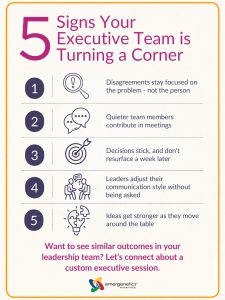
- Disagreements stay focused on the problem – not the person
- Quieter team members contribute in meetings
- Decisions stick, and don’t resurface a week later
- Leaders adjust their communication style without being asked
- Ideas get stronger as they move around the table
Your next steps
I’m optimistic about what teams can do when they approach their differences with curiosity. In fact, we found that after an Emergenetics Meeting of the Minds, 92% of participants gained practical applications for their current role, more than 80% enhanced self-awareness and nearly 70% reported improved working relationships. That’s what happens when people stop seeing each other’s differences as obstacles and start seeing them as resources.
The most successful leadership teams I know are full of strong personalities. And, they know how to bring those perspectives together to achieve a common objective.
Turn your leadership team’s perspectives into a competitive advantage with a customizable executive session built around their challenges and needs.
Interested in learning more? Contact us at brains@emergenetics.com or fill out our form below.
FAQs
Q: How do you manage strong personalities on a team?
A: Start by making everyone’s differences in thought and behavior visible with a shared framework such as the Emergenetics Profile. Use neutral, positive language to describe those differences, then build psychological safety, agree on how decisions will get made and empower each person to flex toward one another.
Q: Why is it important for leaders to address workplace conflict?
A: Unaddressed friction takes up time and energy. Managers spend an average of 4.44 hours per week addressing interpersonal conflict, or nearly 29 working days per year. Naming differences early and agreeing on how the team will work together can help leaders reclaim that time for more productive outcomes.
Q: Why do the same decision points keep resurfacing on some teams?
A: It’s often because the decision-making process was unclear. Agreeing in advance on who gives input, who makes the final call and how the team will check in afterward keeps decisions from being reopened. If you notice your team is really stuck, it may also be due to uncertain conditions affecting their ability to move forward. In this instance, take a look at The Uncertainty Solution.
 Print This Post